
The Relatable Struggle: The "Yeah, I Know That" Trap
We have all had this moment. You are using a language app, or reading a news article in your target language. You nod along. You understand the words. You think, "Okay, I’ve got this. I’m making progress."
Then, five minutes later, you try to tell a friend what you just read.
And you crumble.
You stumble over simple prepositions. You forget the specific conjugation. The sentence that seemed so clear on the page is impossible to form in your mouth.
This isn't just you having a bad day. It is a documented cognitive phenomenon called "The Illusion of Competence." You confuse recognizing a word with owning it.
The Simple Science: "Noticing the Hole"
I recently dug into a study published in the TESOL Working Paper Series titled "The Output Hypothesis: From Theory to Practice".
The researchers, Pannell, Partsch, and Fuller, break down why this happens. They explain a concept called "The Noticing Function."
Here is the plain English version: When you listen or read (Input), your brain is lazy. It uses "semantic processing"—it scans for keywords just to get the gist. It skips over the hard stuff like grammar structures because it doesn't need them to understand the meaning.
But when you speak (Output), your brain is forced to switch gears. You can't just "get the gist"; you have to build the machine.
The study argues that speaking is the trigger that forces you to "notice the hole" in your knowledge. You literally cannot see the gap in your skills until you attempt to bridge it with a sentence.
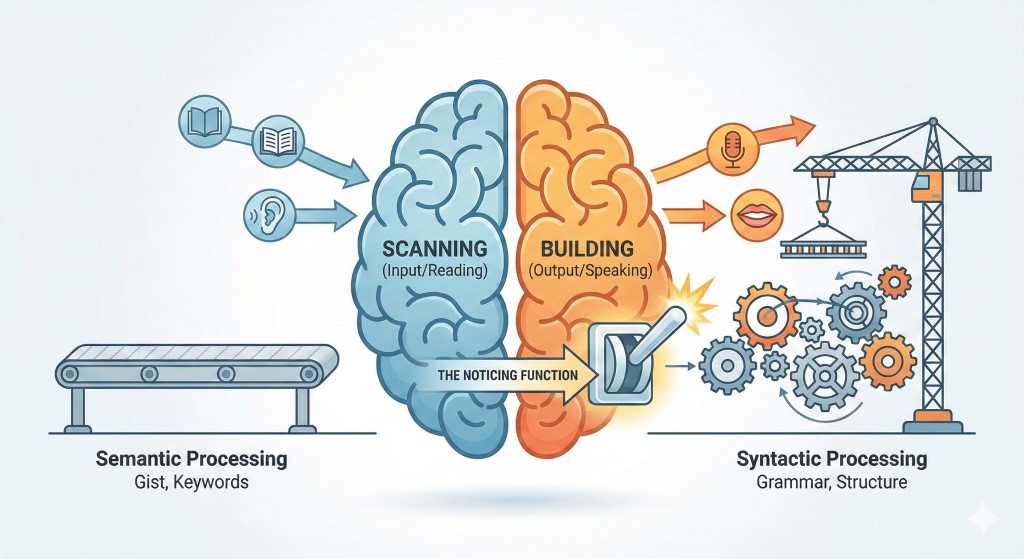
Why It Matters
If you are only using apps that ask you to fill in blanks or match pairs, you are never triggering this "Noticing Function." You are staying in the comfortable zone of semantic processing.
The study emphasizes "Pushed Output"—being forced to produce language in unfamiliar areas. Without this "push," you might understand B2 level content but stay stuck speaking at an A2 level forever because you never force your brain to do the heavy lifting of syntactic processing.
The Solution: A Simulator for "Pushed Output"
This is exactly why I stopped using standard flashcard apps and built DialogoVivo.
I needed something that would force me to "Notice the Hole" in my Polish, but without the embarrassment of freezing up in front of a real person.
I designed the app around Goal-Oriented Scenarios (like "Negotiating a price" or "Explaining a technical problem").
- The Push: You can't just click "Next." You have to actually formulate the sentence to achieve the goal. This forces the "Noticing Function" to kick in.
- The Patch: When you inevitably stumble (because you noticed a gap), our AI Validation Agent doesn't just let it slide. It provides the missing piece—the correct grammar or vocabulary—instantly, in your native language.
This turns the scary moment of "I don't know how to say this" into a micro-learning moment, exactly as the researchers suggest.
Try Finding Your Gaps
You don't know what you don't know until you try to say it.
If you want to test where your actual "gaps" are, you can try running a simulation in DialogoVivo. It’s better to freeze up in front of an AI than in front of a waiter.
It’s available on Google Play if you want to give it a spin.