
The Relatable Struggle: The "Osmosis" Fantasy
We all have the same daydream. We think, "If I really want to learn Spanish, I just need to move to Spain."
We assume language learning works like osmosis. If we just sit in a café in Barcelona or an office in Warsaw long enough, the grammar will seep into our pores, and we will wake up fluent.
But then reality hits. You move to the country. You hear the language for 8 hours a day. You understand what people are saying to you. But when you try to order a coffee or explain a problem to a mechanic, you still stumble. You rely on the same five verbs you learned in high school.
You are an expert listener, but a novice speaker.
The Science: Input vs. Pushed Output
This phenomenon isn't a personal failure; it is a linguistic fact.
We recently analyzed a fascinating interview with Merrill Swain, a professor from the University of Toronto who shattered the "input is enough" myth.
Swain spent years evaluating Canadian "French Immersion" programs. These were students who were surrounded by French in the classroom. They had massive amounts of "Input" (listening and reading).
According to traditional theories (like Krashen’s Input Hypothesis), these kids should have been perfectly fluent.
But they weren't.
Swain found that while the students understood French well, they didn't develop full proficiency. Why? Because they weren't being forced to produce the language enough.
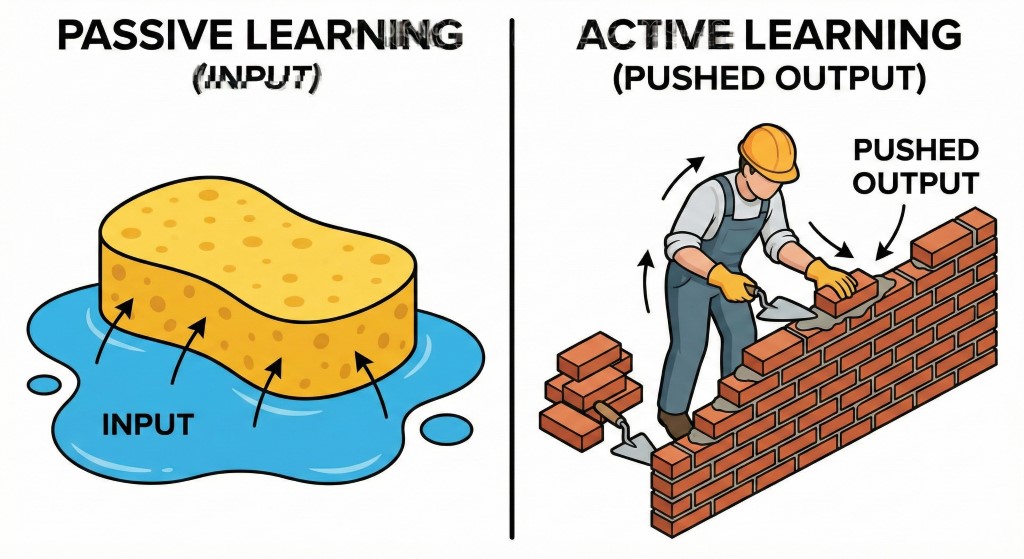
Swain proposed the Output Hypothesis. She argues that speaking (output) triggers three crucial cognitive processes that listening (input) simply cannot:
- Noticing the Gap: When you listen, you can fake it. You get the gist. But when you speak, you hit a wall. You realize, "I don't actually know the conjugation for this verb." Producing language forces you to notice the holes in your knowledge.
- Hypothesis Testing: Speaking is essentially running a scientific experiment. You think, "I think this is how I say it," and you test it. If you are understood, your hypothesis is confirmed. If not, you adjust.
- Metalinguistic Reflection: Swain calls this "Languaging". It’s the process of talking through a concept to understand it. Language isn't just a way to report what you know; it is a tool for figuring out what you know.
Why It Matters
If you are relying solely on "listening" (Netflix, podcasts, or even living abroad silently), you are missing the Hypothesis Testing phase.
You are like a coder who reads documentation all day but never writes a line of code. You understand the theory, but you can't build the app.
Swain notes that without the pressure to produce output, learners can bypass grammatical accuracy and just rely on context clues. To actually master the structure of a language, you must be "pushed" to use it.
The Solution: A "Hypothesis Testing" Sandbox
The problem with the real world is that it is a terrifying place to test hypotheses. If you "test" a sentence on a rude waiter and get it wrong, the social pain is real.
This is why we built DialogoVivo.
I wanted to apply Swain’s Output Hypothesis without the social anxiety. We built the app to be a "Safe Sandbox" for output.
- Forced Languaging: Unlike apps that let you just tap buttons, DialogoVivo forces you to speak or type full sentences to achieve specific goals (like "Negotiating a price"). It forces you to "notice the gap".
- Immediate Hypothesis Validation: When you test a sentence, our AI Validation Agent acts as the feedback loop. It doesn't just let errors slide for the sake of politeness; it catches them and explains why you were wrong in your native language.
- Zero Anxiety: You can test the same sentence 50 times. The AI will never get impatient.
Start "Languaging" Today
You don't need to move to a new country to start using the Output Hypothesis. You just need to stop listening and start speaking.
If you want a safe place to test your language hypotheses before trying them in the real world, you can try the DialogoVivo prototype on Android.