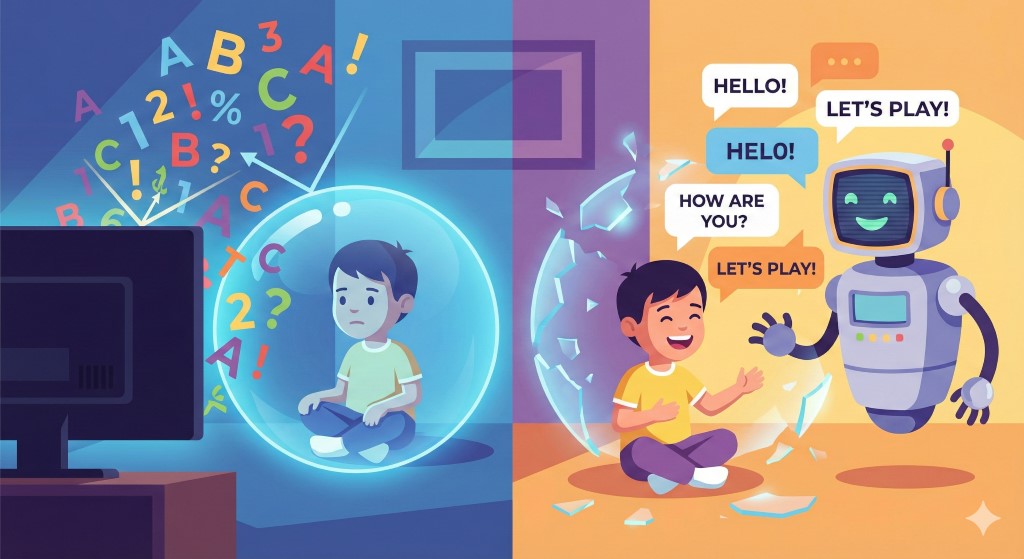
You have likely heard the advice: "Just immerse yourself. Listen to podcasts. Watch TV. The language will come."
So you do. You listen for hundreds of hours. You understand the hosts. You laugh at the jokes in the sitcoms. But when you try to construct a simple sentence yourself, you stumble. You sound like a broken robot.
You feel like you have "filled the tank," so why won't the engine start?
The Simple Science: The Case of "Jim"
We recently read a review by Victor A. Birkner that analyzes the decades-long debate between "Input" (listening) and "Output" (speaking).
Birkner highlights a famous and somewhat tragic case study that perfectly illustrates why listening isn't enough: The case of "Jim."
Jim was a hearing child born to deaf parents. His only exposure to spoken English was through television. He watched TV constantly. If the "Input Hypothesis" (the idea that listening is all you need) were true, Jim should have been fluent.
He wasn't.
When researchers tested him at age four, his speech was severely delayed and ungrammatical. He had the "input," but he lacked the interaction. It wasn't until he started having real conversations with adults—where he was forced to respond and be understood—that his grammar corrected itself.
Why It Matters: "Me Tarzan, You Jane"
Birkner explains why Jim failed using what he calls the "Me Tarzan, You Jane" principle.
If someone says "Me Tarzan, You Jane," you understand exactly what they mean. You get the message.
Because you understand the meaning, your brain gets lazy. It doesn't bother analyzing the grammar. It doesn't ask, "Wait, where is the verb 'to be'?"
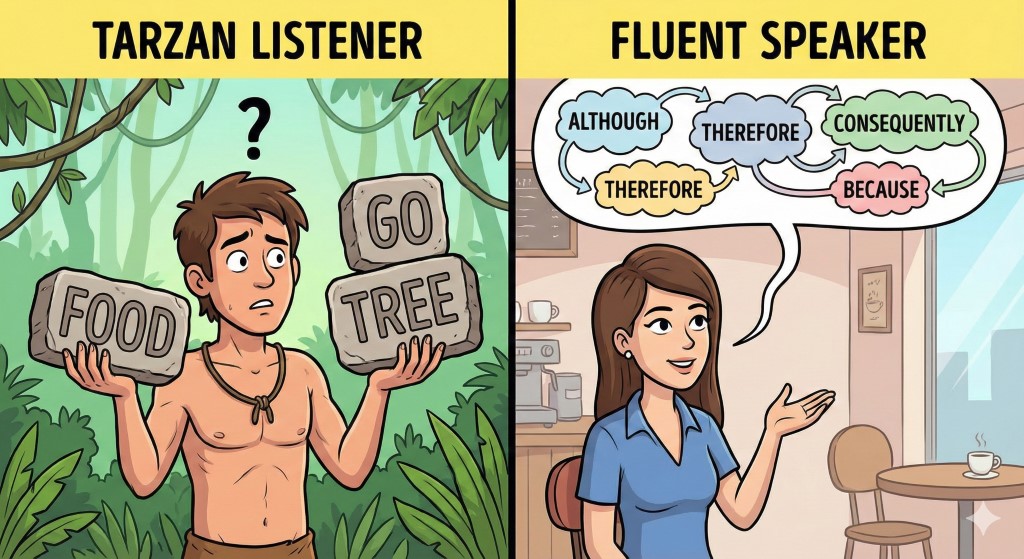
Input allows you to be lazy. You can understand meaning without learning syntax. Output forces you to work. To say that sentence correctly ("I am Tarzan, and you are Jane"), you have to understand the grammar. You can't fake it.
If you are just listening, you are training your brain to be a "Tarzan listener"—understanding the gist but missing the structure.
The Solution: Forced Interaction
Birkner concludes that while input is necessary to provide the data, Output is necessary to trigger mastery. You need "Comprehensible Output"—the struggle to make yourself understood precisely.
This is the engineering philosophy behind DialogoVivo.
We built the app to save you from the "Jim" trap. Instead of passively watching a scenario, you are an active participant in it.
- The "Push": You aren't watching a video of someone ordering coffee. You have to order the coffee. You have to achieve the goal.
- The Structure: Unlike a TV show, the app waits for your response. It forces you to move from "Me Tarzan" (understanding) to "I would like a coffee" (grammatical production).
- The Safety Net: Jim improved because adults guided him. Our Validation Agent acts as that guide, gently correcting your "Tarzan speak" into fluent phrasing instantly.
Stop Watching, Start Interacting
If you feel like you have watched enough TV to be fluent but still can't speak, you might be stuck in the "Input Trap." You need to switch gears to interaction.
If you want to practice "Comprehensible Output" without the pressure of a real human conversation, give DialogoVivo a try. It’s designed to turn passive listeners into active speakers.