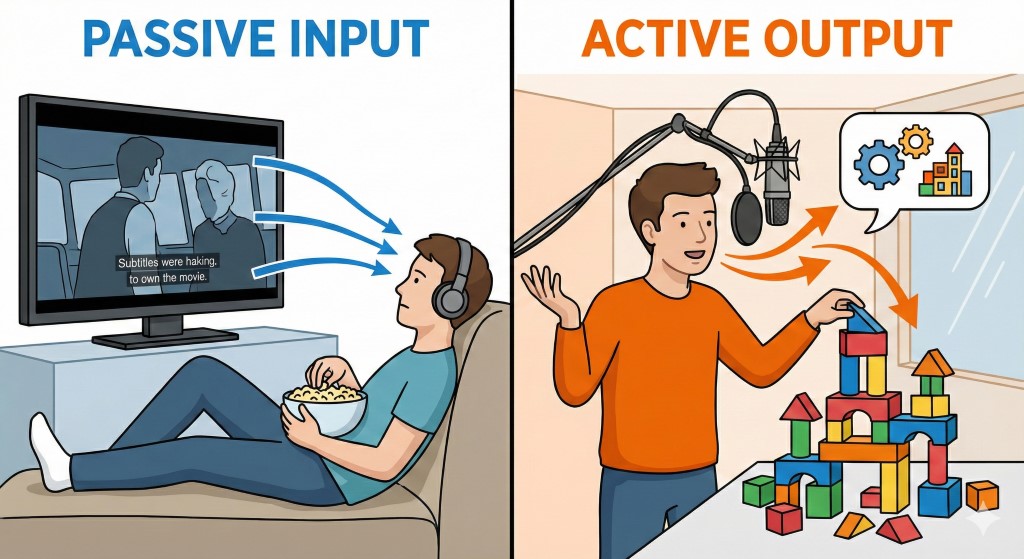
The Relatable Struggle
I used to believe the biggest lie in language learning: "Just listen, and the speaking will come."
I spent years watching movies in English and reading technical documentation. I understood everything. But the moment I had to open my mouth to speak—whether to a client or a cashier—I froze. My mind went blank.
I knew the words. I knew the grammar rules. So why couldn't I form a sentence?
I decided to dig into the research to find out why. It turns out, this isn't a personal failure. It’s a cognitive gap called the Output Hypothesis.
The Simple Science: Semantic vs. Syntactic
In the 1980s, researcher Merrill Swain studied students who were immersed in French for years. They listened to French all day. They read French. Yet, their speaking skills were significantly weaker than those of native speakers.
Swain realized that Input (listening/reading) and Output (speaking/writing) use two completely different parts of the brain.
- When you listen (Input): You use Semantic Processing. Your brain scans for keywords just to "get the gist." You can understand a sentence like "Yesterday I go store" without noticing the grammatical error.
- When you speak (Output): You are forced into Syntactic Processing. You can't just "get the gist"—you have to build the structure. You have to decide: Is it "go" or "went"? "To" or "at"?
Passive input never forces your brain to do the heavy lifting of building sentences. It’s like trying to learn how to play piano by watching concerts. You understand the music, but your fingers don't know where to go.
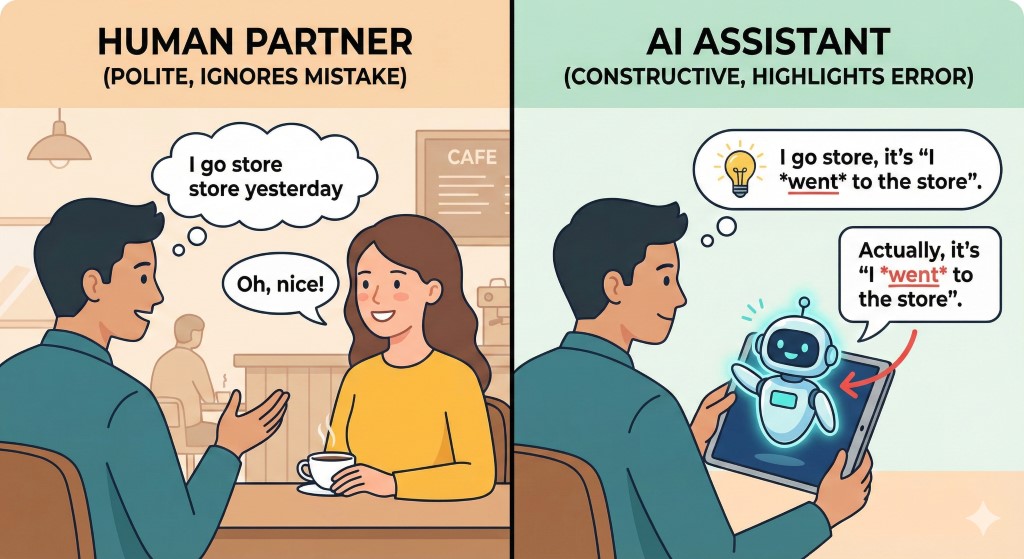
The Danger of "Polite" Humans
"Okay," you might say. "I'll just practice with a human partner."
That works, but it has a hidden flaw. A study by Shehadeh (2003) found that when learners make mistakes, human partners rarely correct them.
If you say "The chair is near of the bed," a human understands you. They won't stop the conversation to say, "Actually, it's 'near the bed'." They are too polite, or they just want to keep chatting.
The study found that over one-third of hypothesis testing episodes (where learners tried a new phrase) resulted in errors that went completely unchallenged. The result? You assume you are correct, and the error becomes "fossilized" in your brain forever.
The Solution: A Partner That Isn't Polite
I realized I needed a way to bridge the gap between "Understanding" and "Building," but I needed a partner that:
- Forced me to produce output (Syntactic processing).
- Wasn't too polite to correct me (Feedback loop).
- Didn't trigger my anxiety (Safe environment).
Since I’m a software engineer, I built a tool to solve this specific problem. I call it DialogoVivo.
It’s an AI-driven "conversation simulator." Instead of open-ended chats, it drops you into specific role-play scenarios (e.g., Convince a taxi driver to take a shortcut).
You must produce output to achieve the goals. But unlike a human, the built-in Validation Agent catches every single mistake—grammar, phrasing, or awkward vocabulary—and explains it instantly in your native language.
It creates what researchers call a "Safe Environment." You can crash the plane in the simulator a hundred times, so you don't crash it when you speak to a real person.
Try The Theory
If you have been stuck in the "I understand but can't speak" trap, you need to stop consuming and start producing.
I released DialogoVivo as a free tool on Android. It’s designed to push you from Semantic to Syntactic processing without the social anxiety.
Check out DialogoVivo on Google Play
Scientific References:
Swain, M. (1985). The Output Hypothesis: Just Speaking and Writing Aren't Enough. Read Paper
Shehadeh, A. (2003). Learner output, hypothesis testing, and internalizing linguistic knowledge. Read Paper