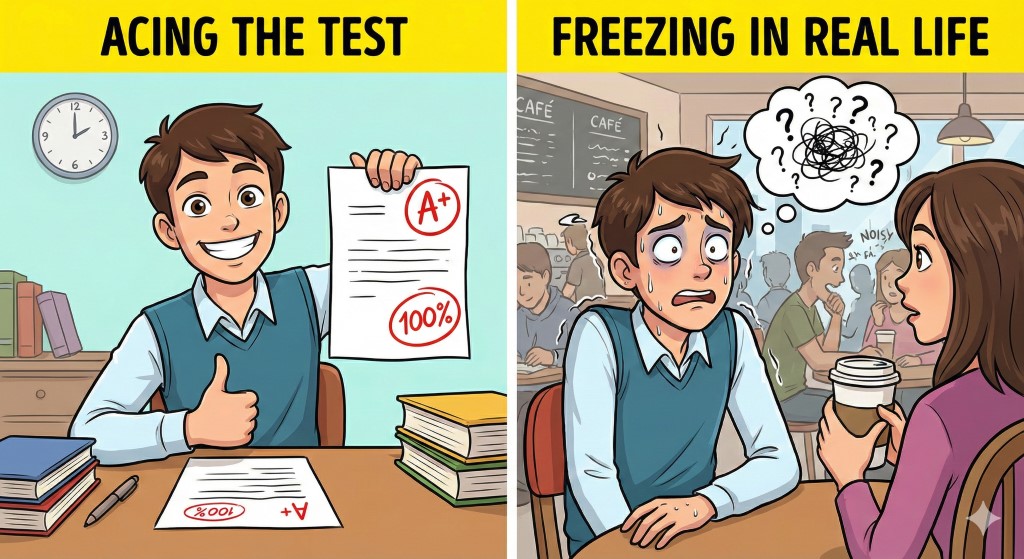
The Relatable Struggle: The "Test-Ready" Trap
You have experienced this. You spend a month cramming phrasal verbs. You take a quiz, fill in the blanks, and score 95%. You feel like a genius.
Then, two weeks later, you are in a Zoom meeting or at a coffee shop, and you need to use one of those verbs.
Gone.
You know you studied it. You know you passed the test. But in the heat of the moment, your brain serves up a 404 Error. Why does your "knowledge" evaporate the moment you step out of "study mode"?
The Simple Science: Explicit vs. Implicit Knowledge
We recently read a critique by Julie Whitlow in TESOL Quarterly that explains this frustration perfectly. She was analyzing a study on language "output" (speaking/writing) and pointed out a massive flaw in how we often measure learning.
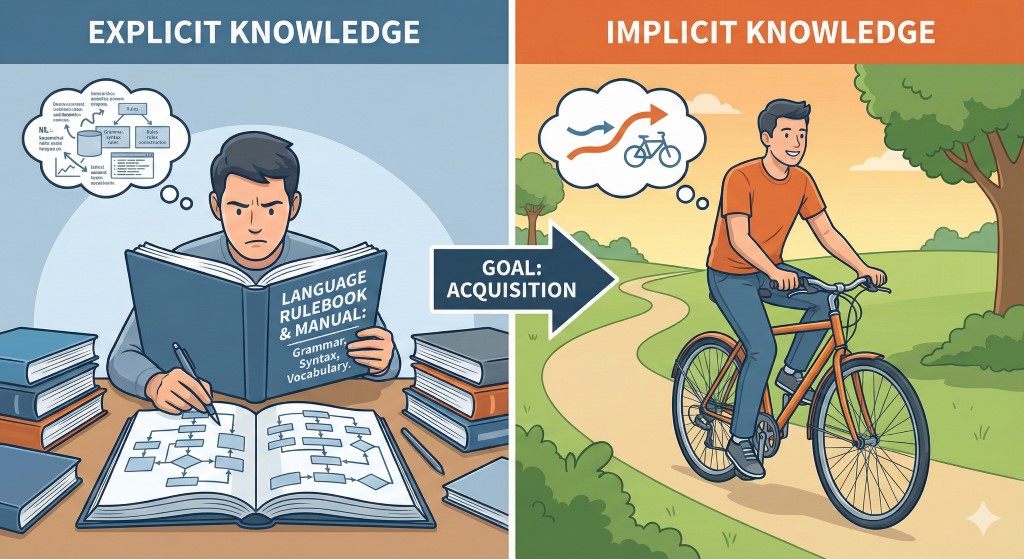
Whitlow argues that many traditional learning tasks—like rewriting sentences to include a specific grammar rule—are "contrived". When you are forced to use a specific rule 80% of the time in a lab setting, you aren't really "acquiring" the language. You are just demonstrating Explicit Knowledge.
- Explicit Knowledge is knowing about the language (e.g., "I add -ed for past tense").
- Implicit Knowledge is the ability to use it spontaneously without thinking.
Whitlow points out that short-term, forced practice often tricks us. We perform well in the moment because we are "hyperaware" of the rule. But without longitudinal (long-term) practice and spontaneous usage, that knowledge never becomes implicit. It stays in your short-term RAM and never gets written to your hard drive.
Why It Matters
This helps explain why apps that focus on matching pairs or filling in blanks often feel satisfying but fail to produce results in the real world.
They are building Explicit Knowledge. They are testing your ability to recall a rule when you know you are being tested on that rule.
But real life is spontaneous. Real conversations don't come with a header saying, "Please use the Past Hypothetical Conditional in this sentence." If your practice isn't spontaneous, you aren't training for reality.
The Solution: Spontaneity + Spaced Repetition
As engineers, we looked at this problem as a deployment issue. How do we move code (language) from a "Staging Environment" (your short-term memory) to "Production" (long-term fluency)?
We built DialogoVivo to solve the two specific problems Whitlow highlighted: Artificiality and Time.
- Spontaneous Output (The Anti-Script): Whitlow criticized tasks where students just reconstructed sentences. In DialogoVivo, we don't give you a script. We give you a Goal (e.g., "Convince the doctor you need an appointment today"). You have to formulate your own sentences to get there. This forces spontaneous production, bridging the gap to Implicit Knowledge.
- Longitudinal Tracking (The Leitner System): Whitlow noted that a 4-hour experiment isn't enough to prove learning. We integrated a Spaced Repetition System (SRS) directly into the app. If you struggle with a phrase today, the algorithm ensures you see it again in 3 days, then 7 days, then a month. We track the long-term retention, not just today's quiz score.
Stop Cramming, Start Simulating
If you are tired of being "Test-Ready" but "Life-Unready," you might need to change how you practice. You need to move away from forced drills and towards spontaneous, goal-oriented output.
If you want to test your Implicit Knowledge in a safe environment, you can try a simulation on the DialogoVivo prototype on Android.